

You didn’t lose your creativity. You lost room for it.
There comes a moment in many creative businesses when the spark that once felt effortless begins to dim. Not because you’ve changed — but because the business around your creativity has grown louder, heavier, and more demanding.
The work still gets done.
The clients are still there.
But something inside you feels distant.
This post names that moment — and reframes what’s actually happening beneath it.
The tension no one prepares creatives for
You are still creative at your core.
That hasn’t disappeared.
But running a business has a way of quietly draining the very part of you that made you start in the first place.
The to-do list grows.
The inbox fills.
The pressure to produce — and perform — mounts.
And slowly, creativity becomes something you extract instead of something you experience. You find yourself creating from obligation, not inspiration.
You miss yourself.
The curious, playful, expressive version of you.
Creativity doesn’t disappear. It compresses.
When creativity feels heavy, the instinct is to assume something is wrong:
-
You’re blocked
-
You’re burned out
-
You’ve lost your edge
But the truth is more nuanced.
Creativity doesn’t survive inside constant productivity.
It needs space, not pressure.
What you’re feeling isn’t a lack of creativity — it’s a lack of room for it to breathe.
The hidden cost of always creating “on purpose”
As businesses mature, creativity often becomes instrumentalized.
Every idea must:
-
convert
-
perform
-
justify its existence
And over time, that expectation quietly suffocates experimentation.
When every creative act has to do something, creativity stops feeling safe. It becomes another output to manage — another place to be evaluated.
This is the emotional cost of being “on” all the time.
Not exhaustion — but disconnection.
Pinterest didn’t fix creativity. It revealed what it needed.
Pinterest didn’t re-ignite creativity because of trends, pins, or performance.
It worked because it offered something most creative founders had lost:
permission to explore without expectation.
Pinterest functioned as a visual environment where ideas could exist without being monetized. Where curiosity came before strategy. Where collecting felt playful instead of productive.
That’s the signal.
Not “do Pinterest.”
But: creativity returns when pressure leaves the room.
The shift isn’t strategic. It’s relational.
Reigniting creative identity isn’t about systems or output.
It’s about reconnection.
Reconnecting to:
-
your curiosity
-
your visual instincts
-
your voice
-
your identity outside of productivity
When creative space returns, strategy becomes clearer — not because you forced it, but because inspiration finally has somewhere to land.
This is the difference between running a creative business and living inside one.
Creativity needs rhythm — not demand.
Creative energy doesn’t respond to urgency.
It responds to consistency without pressure.
When you allow creativity to exist without immediately assigning it a job, something important happens:
You begin to trust yourself again.
And that trust is what sustains creative businesses long-term — far more than output ever could.
Reflection
What part of your creativity have you been neglecting — and what would it look like to give it space again?
Don’t answer quickly.
Let it surface.
A calm next step, if you want one
If you want Pinterest to feel like a creative playground again — not another obligation — The Styled Pin Collection exists to reduce friction and decision pressure, so creating can feel expressive instead of strategic.
And if you want clarity on how to rebuild a visibility plan that supports your creativity instead of draining it, the VEIL Visibility Audit offers thoughtful diagnosis before any execution.
Your creativity is still there.
It’s just waiting for room.
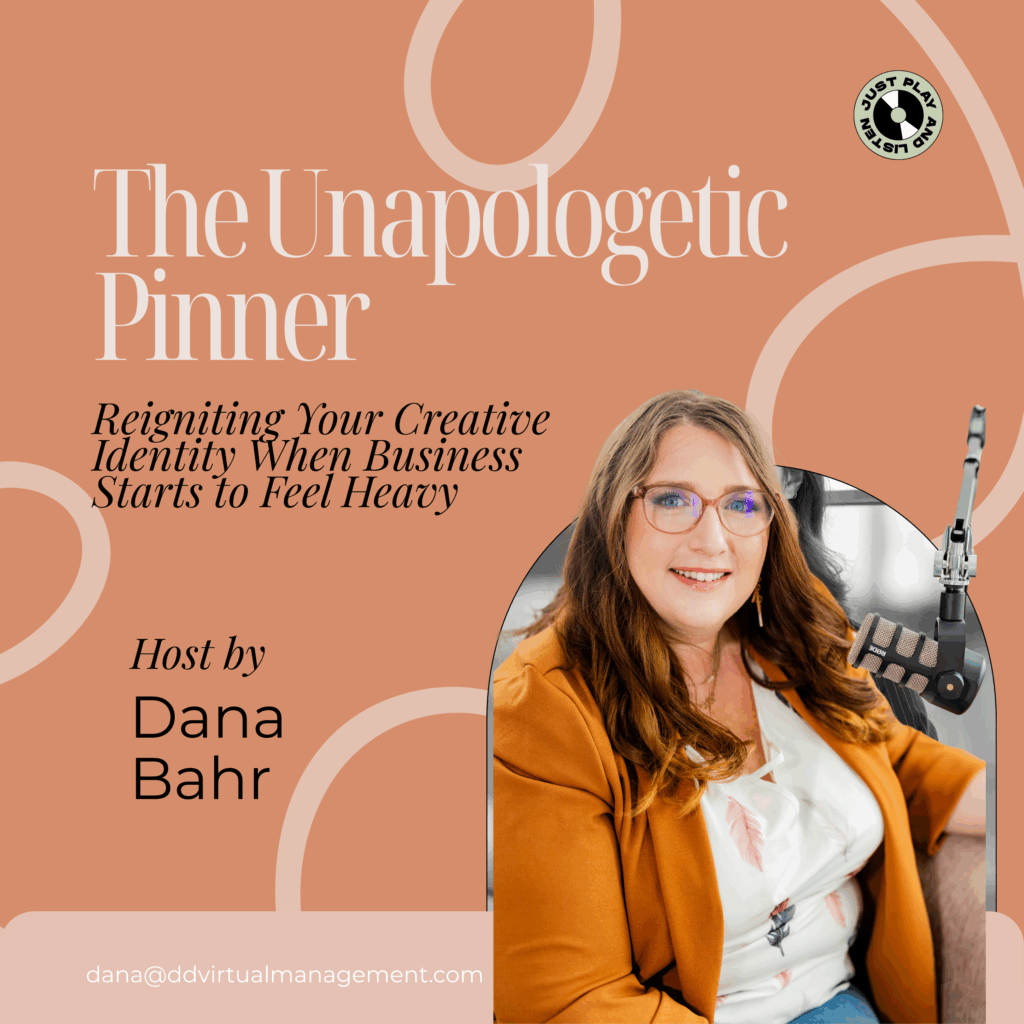
Source: Adapted and strategically reframed from the podcast episode “Reigniting Your Creative Identity When Business Starts to Feel Heavy” on The Unapologetic Pinner podcast.

+ show Comments
- Hide Comments
add a comment